One of the most common questions I hear from patients considering hip or knee replacement is simple:
“How long will it last?”
Many people have heard that joint replacements only last 10 to 15 years and assume they should wait as long as possible before surgery. That idea comes largely from older data based on implants and materials used in the 1980s and 1990s. But joint replacement technology has evolved dramatically since then.
Modern surgical techniques, improved fixation methods, robotics in select cases, and especially better implant materials have changed what we expect from joint replacement today. One of the biggest advances was the introduction of highly cross-linked polyethylene in the early 2000s, which significantly reduced implant wear and loosening. Simply put, today’s implants are not the same as those used a generation ago.
What Current Data Actually Shows
Large national joint registries track hundreds of thousands of patients over decades, giving us real-world data about implant durability. One of the most comprehensive sources is the Australian Orthopaedic Association National Joint Replacement Registry (AOANJRR).
According to contemporary AOANJRR data:
- Total hip replacement: approximately 92–94% survivorship at 20 years (based on Kaplan–Meier cumulative revision data from modern primary total hip replacements).
- Total knee replacement: similarly demonstrates approximately 92–94% survivorship at 20 years in modern primary total knee replacement cases.
Across contemporary registry reports, 20-year survivorship for both hip and knee replacements is well above 90% in most modern series.
Hip resurfacing procedures, when performed in appropriately selected male patients, also show excellent long-term durability. The Bone & Joint Journal data demonstrates approximately 94–96% survivorship at 20 years for Birmingham hip resurfacing in appropriately selected male patients.
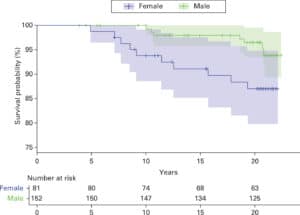
These figures are derived from cumulative percent revision data reported in national registry annual reports. They reflect modern implants, modern surgical techniques, and contemporary patient selection — not outdated technology from decades ago.
Partial Knee Replacement Is Different
Partial knee replacement is a more nuanced procedure. Its success depends heavily on patient selection, surgical precision, and implant choice. According to AOANJRR long-term data on unicompartmental knee replacement, 20-year survivorship is approximately 80–85%, depending on implant type and patient factors. This data also highlights that fixed modular unicompartmental knee arthroplasties (UKA) generally have lower revision rates (16% at 15 years) than mobile-bearing (23%) or all-polyethylene (26%) options.
This does not mean partial knee replacement is less effective. In the right patient, it can be an excellent operation that preserves more of the natural knee and often feels more natural afterward. It simply means that choosing the right procedure for the right patient matters.
The Risk of Waiting Too Long
It’s completely reasonable to want your joint replacement to last as long as possible. But focusing only on longevity can sometimes lead patients to delay surgery longer than they should. Living for years with severe arthritis, poor sleep, limited mobility, and declining activity doesn’t improve outcomes. In some cases, prolonged dysfunction can actually make recovery harder and reduce the overall benefit patients experience after surgery.
There is very little scientific evidence that patients should wait until a specific age before having joint replacement. Age alone is not the deciding factor.
A better question is: How much is this affecting your quality of life?
When Is the Right Time?
When arthritis consistently limits your ability to live the life you want — despite appropriate non-surgical treatment — that’s often the more meaningful signal that it may be time to consider surgery.
Modern joint replacement is a durable, reliable reconstruction that, for many patients, provides decades of improved comfort, mobility, and function.
So instead of asking, “How long will it last?” a more useful question is: “Is this the right time for me?”
That’s a decision best made together with your orthopedic surgeon, based on your symptoms, goals, activity level, imaging findings, and overall health.