
Hip Conditions
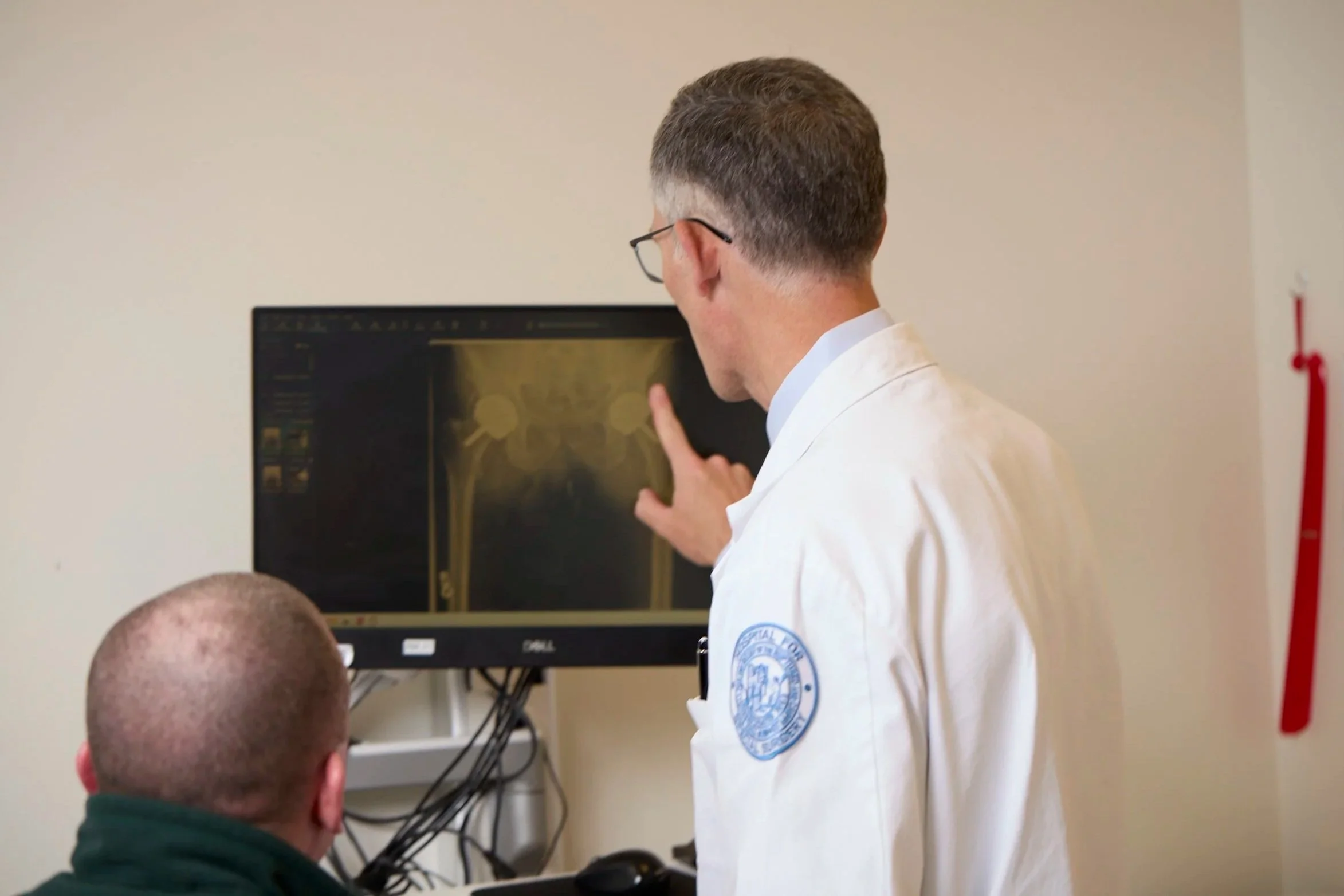
Hip pain has many causes. Understanding your specific condition is the first step toward finding the right treatment. Dr. McLawhorn diagnoses and treats the full spectrum of hip conditions — from the most common to the most complex. The conditions below are the most frequent reasons patients ultimately pursue hip replacement surgery.
Hip Arthritis
What Is Hip Arthritis?
Arthritis is characterized by damage to the surfaces of the hip joint where they make contact. The femoral head (ball) and acetabulum (socket) are normally covered by protective cartilage. When cartilage breaks down due to aging, inflammatory disease, or wear and tear, bone rubs directly against bone — causing pain, stiffness, and reduced mobility. In advanced cases, bone spurs and cysts develop within the joint.
-
Osteoarthritis (OA)
The most common form — gradual degeneration of hip cartilage over time due to wear and tear. It develops slowly, resulting in bone-on-bone contact, pain, stiffness, and restricted motion. There is a genetic predisposition and it is most frequently seen in patients of European ancestry.
Inflammatory Arthritis
A group of autoimmune disorders in which the body's immune system attacks the synovial lining of the joints. Common types include rheumatoid arthritis, psoriatic arthritis, ankylosing spondylitis, juvenile idiopathic arthritis, and systemic lupus erythematosus. These conditions often affect multiple joints simultaneously and can lead to progressive joint damage. Patients may also develop secondary osteonecrosis as a complication of chronic corticosteroid therapy used to manage their disease.
Secondary Arthritis
Arthritis caused by another hip disorder — most commonly trauma, prior hip infection, avascular necrosis, or structural abnormalities such as hip dysplasia.
-
Stiffness in the morning or after prolonged sitting
Reduced range of motion — difficulty crossing legs or putting on shoes and socks
Aching in the hip or groin after activity
A crunching, grinding, or clicking sensation with hip movement
Pain that wakes you from sleep or radiates to the thigh or buttocks
A limp or difference in leg lengths
-
Non-surgical: rest, weight management, physical therapy, NSAIDs, cortisone injections, PRP therapy, assistive devices.
Surgical: hip resurfacing or total hip replacement when conservative care is no longer effective.
Hip Dysplasia
What Is Hip Dysplasia?
Hip dysplasia is a developmental condition in which the hip socket does not fully cover the ball of the hip joint, resulting in abnormal joint mechanics. More severe cases are often identified and treated during infancy or childhood, but milder forms may go unrecognized until adulthood. Over time, inadequate coverage of the femoral head leads to increased stress on the cartilage and labrum, accelerating joint wear and increasing the risk of early-onset hip osteoarthritis. In many cases, hip dysplasia ultimately leads to the need for hip replacement surgery.
-
Similar to hip arthritis
Persistent or intermittent pain in the hip, groin, buttocks, thigh or knee
Pain exacerbated by prolonged standing or sitting (static overload of the hip joint)
Severe forms of hip dysplasia may present with back pain
-
Genetic predisposition — family history increases risk; more common in females
Developmental abnormalities during infancy or childhood hip formation
Factors during fetal development — breech position, limited womb space, tight swaddling
-
The abnormal shape of the dysplastic socket can make implant positioning technically challenging. There are frequently concomitant abnormalities of the shape and size of the top of the thighbone as well. Dr. McLawhorn carefully plans each case using advanced imaging and uses specialized implants and techniques designed for dysplastic anatomy — including specialized implants and precise robotic guidance for implant placement
-
Non-surgical: physical therapy, weight management, anti-inflammatory medications, cortisone or PRP injections.
Surgical: total hip replacement is recommended when arthritic changes are severe and non-surgical care is no longer adequate.
Hip Necrosis
What Is Hip Necrosis?
Hip necrosis—also called avascular necrosis (AVN) or osteonecrosis—occurs when the blood supply to the femoral head (the ball of the hip joint) is disrupted. Without adequate blood flow, the bone weakens and may collapse. After joint surface collapse, arthritis develops, leading to pain, stiffness, and loss of function. Once collapse of the joint surface has occurred, total hip replacement is usually the most effective treatment.
-
Injury — a broken or dislocated hip can disrupt blood flow
Heavy alcohol use — fatty deposits in blood vessels reduce circulation
Steroid medications — long-term or high-dose corticosteroids affect bone health
Medical conditions — blood clotting disorders, vasculitis, HIV, sickle cell disease
Radiation therapy in the pelvic area
Idiopathic — in many cases no specific cause is identified
-
Stage 1 — Early
Blood flow is reduced but bone appears normal on X-ray. Pain may be mild or absent.
Stage 2 — Intermediate
Bone begins to weaken. X-rays show early damage. Pain and stiffness become more noticeable.
Stage 3 — Advanced
Bone begins to collapse. Significant pain and limited movement. The hip may lose its shape.
Stage 4 — Severe
Complete bone collapse with cartilage damage and arthritis. Total hip replacement is typically required.
-
Early stages (1 and 2): medications, physical therapy, core decompression surgery, bone grafting
Advanced stages (3 and 4): total hip replacement is the best treatment once there is surface collapse of the joint
Childhood Hip Disorders
Conditions That Can Lead to Adult Hip Disease
Up to 5% of adults have a history of a hip disorder during childhood. Certain childhood conditions are associated with degenerative hip disease that may ultimately require hip replacement. Dr. McLawhorn has particular expertise in treating these patients — understanding that their hip anatomy is often fundamentally different from typical arthritis patients and requires a customized surgical approach.
Additionally, patients with childhood hip disorders often require hip replacement at a younger age than the typical hip replacement patient. Dr. McLawhorn recognizes that these patients frequently have greater activity demands and higher expectations for function, and he tailors treatment strategies to help them return to an active lifestyle while optimizing long-term outcomes.
-
A condition in which the femoral head slips backward relative to the neck of the femur through the growth plate, typically in overweight adolescents during rapid growth. SCFE causes hip pain, limping, and restricted movement, and can lead to hip impingement and early-onset osteoarthritis due to altered joint mechanics.
-
Temporary loss of blood supply to the femoral head during childhood (ages 4–8), leading to osteonecrosis and femoral head deformation. Most children recover with appropriate management, but some develop residual deformities that predispose them to joint deterioration and early arthritis in adulthood.
Why These Conditions Complicate Adult Hip Replacement
Childhood hip disorders often alter the anatomy of the hip joint, making hip replacement more technically demanding. Common challenges include:
Abnormal socket anatomy – A shallow, misshapen, or malpositioned socket may require specialized surgical techniques
Femoral deformities – Abnormal shape, rotation, or alignment of the femur can complicate implant positioning
Previous surgeries – Prior osteotomies can create scar tissue and alter normal anatomy
Bone loss or poor bone quality – May require bone grafting or specialized implant strategies
Implant selection challenges – Standard implants may not provide an optimal fit
Dr. McLawhorn uses advanced preoperative planning, including special X-rays and 3D CT imaging, and robotic-assisted technology during surgery.
Adults with a history of any of these conditions benefit from a surgeon with specific expertise in complex hip replacement. Call 212-606-1065 (NYC) or 203-705-2113 (CT).