
NYC & Stamford, CT

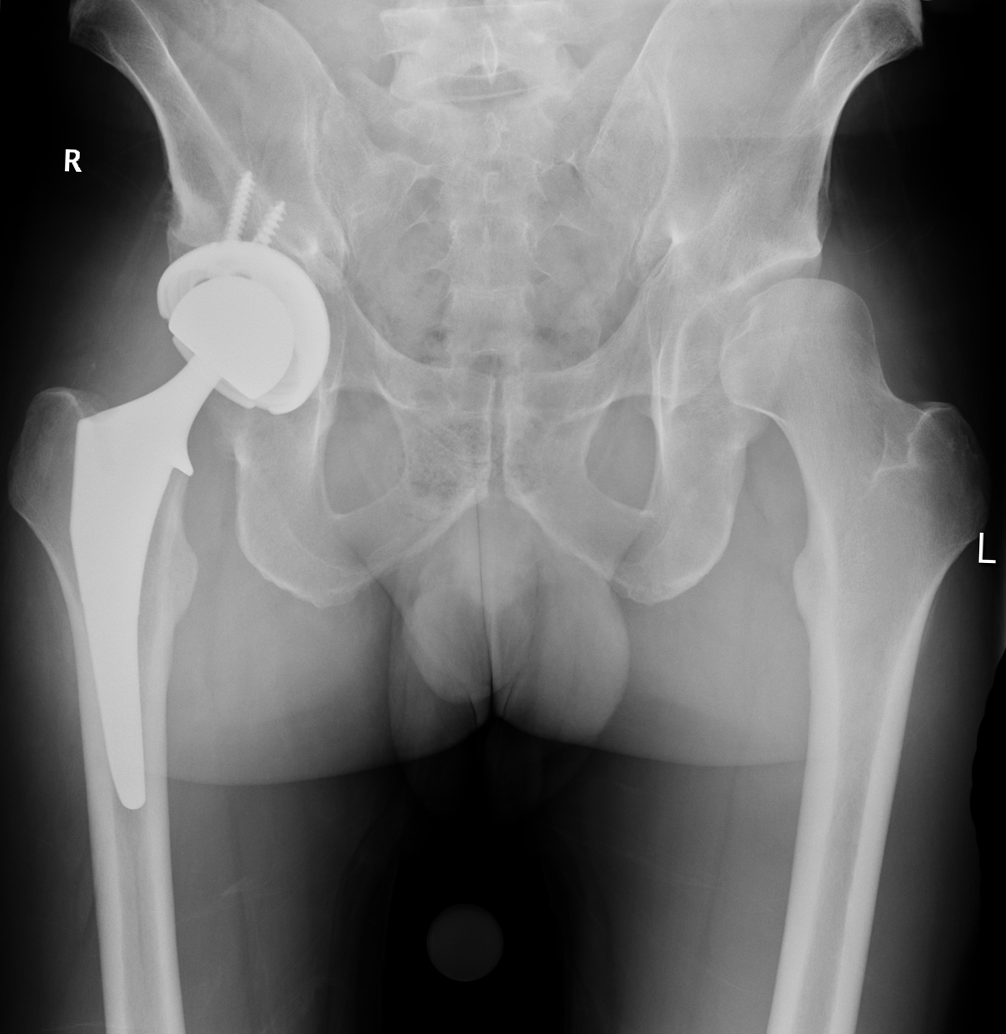
Total Hip Replacement
Hip pain that limits your daily activities doesn't have to define your life. Total hip replacement is one of the most successful procedures in modern medicine — and in the hands of a high-volume specialist like Dr. McLawhorn, most patients experience dramatic, lasting improvement.
Total hip replacement is a surgical reconstruction of the hip joint using prosthetic parts made of special metals, plastic, and/or ceramics.
The procedure removes damaged cartilage and bone and replaces the hip joint's ball and socket with precision-engineered components designed to restore pain-free, natural motion.
It is most commonly performed for hip arthritis, but also for avascular necrosis, hip dysplasia, and other conditions that cause significant joint damage and pain.
The primary goal of total hip replacement is to eliminate pain.
Additional goals include:
Restore hip function and range of motion
Provide a stable hip that does not dislocate
Prevent excessive wear of implanted components
Allow a return to the activities you love
After complete recovery, many patients are so comfortable that they forget they ever had the surgery.
When is hip replacement recommended?
Hip replacement is a deeply personal decision made collaboratively between you and Dr. McLawhorn. In general, surgery becomes appropriate when:
Hip pain significantly interferes with daily life or recreational activities
Pain persists at rest or wakes you from sleep
Pain requires prescription medication to manage
Non-surgical treatments (physical therapy, injections, anti-inflammatories) are no longer providing relief
Delaying surgery too long can lead to worsening joint damage, muscle atrophy, and a more complex procedure. Dr. McLawhorn will advise you on optimal timing.
Surgical Approach: Anterior vs. Posterior
Dr. McLawhorn primarily uses the direct anterior approach — accessing the hip from the front, through a natural gap between muscles rather than cutting through them. This technique is associated with:
Less postoperative pain
Faster recovery
Lower risk of hip dislocation
No hip precautions required after surgery
For patients where the anterior approach is not optimal (due to anatomy or complexity), Dr. McLawhorn is equally skilled in the posterior approach, with modern techniques that reduce its historically higher dislocation risk.
Dr. McLawhorn believes most patients are candidates for anterior approach surgery. Even if you have been told elsewhere that you are not a candidate, a second opinion may be worthwhile.
Anterior vs. Posterior Approach: Key Differences
-
Dislocation risk
Significantly lower
Recovery speed
Faster, no precautions
Postoperative pain
Lower
Suitable for all patients?
Most patients; less ideal for high BMI
Long-term outcome
Equivalent
-
Dislocation risk
Higher
Recovery speed
Slightly slower, precautions
Postoperative pain
Higher
Suitable for all patients?
All patients
Long-term outcome
Equivalent
Implant Materials
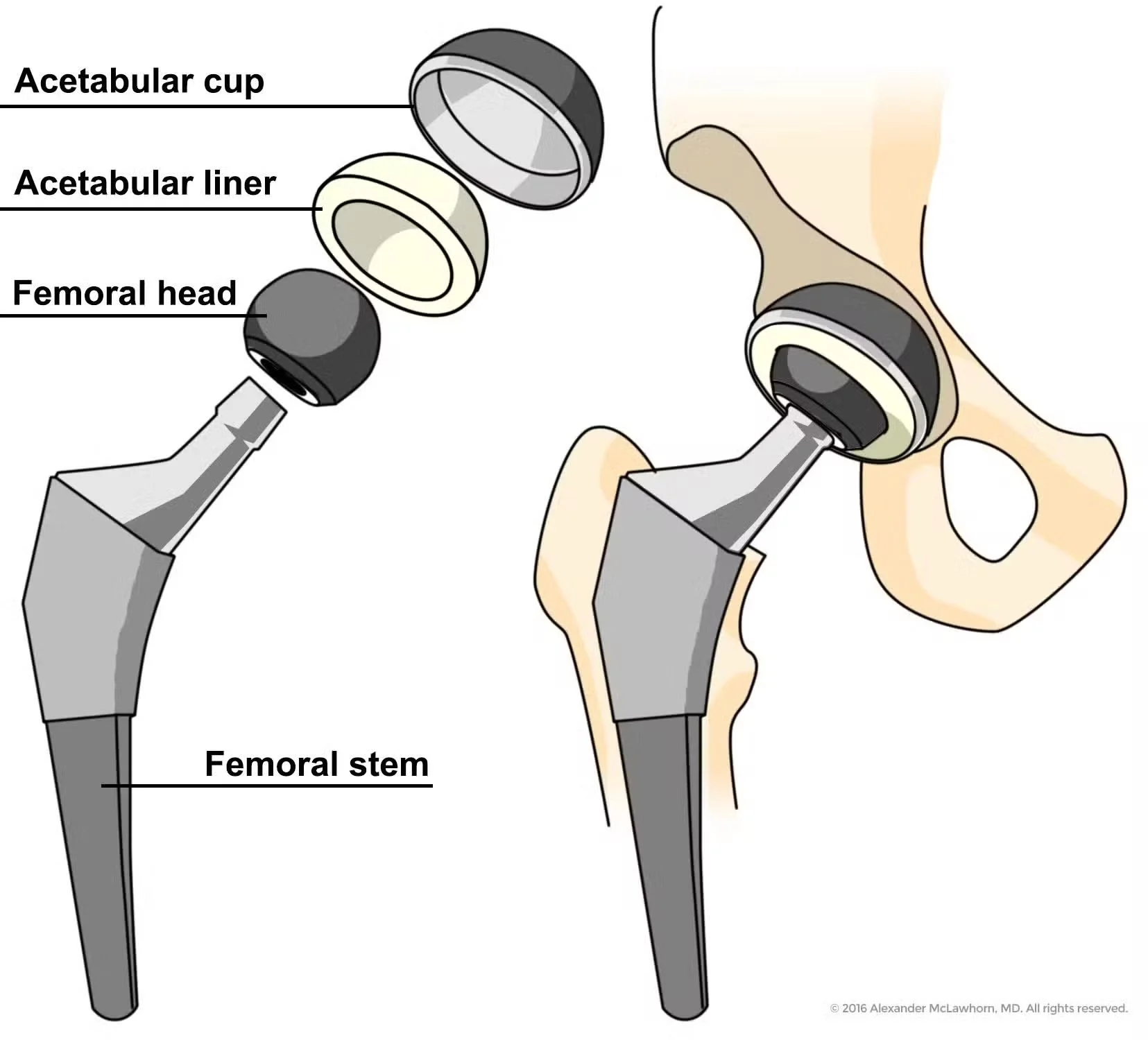
Dr. McLawhorn selects the optimal implant design and materials for each patient based on anatomy, bone quality, age, and lifestyle. Components typically include:
Cup (acetabulum): Titanium or cobalt chrome
Cup liner: Highly cross-linked polyethylene or ceramic
Femoral head (ball): Cobalt chrome, ceramic, or ceramicized metal
Femoral stem: Titanium or cobalt chrome
Fixation: Uncemented (bone ingrowth) or cemented (for patients with poor bone quality)
Surgery & Recovery
During Surgery
Surgery is performed under regional anesthesia (spinal or epidural) with IV sedation. Antibiotics are given beforehand to prevent infection. The procedure typically takes one to two hours.
After Surgery
Most patients go home the same day. You will walk on your new hip immediately using a walker or cane. Key recovery milestones:
Return to work: 2 weeks (depending on job demands)
Walking without aid: 3–6 weeks
Low-impact activities: 6 weeks
Heavy labor and most sports: 3–6 months
Follow-Up Schedule
Dr. McLawhorn sees all hip replacement patients at 6 weeks, 1 year, 5 years, and every 5 years thereafter, with clinical examination and X-rays at each visit.
How long will my new hip last?
Current data suggests that the lifelong risk of revision surgery after contemporary total hip replacement is less than 5%. With continued advances in implant technology and surgical technique, outcomes continue to improve.
Precision Technology
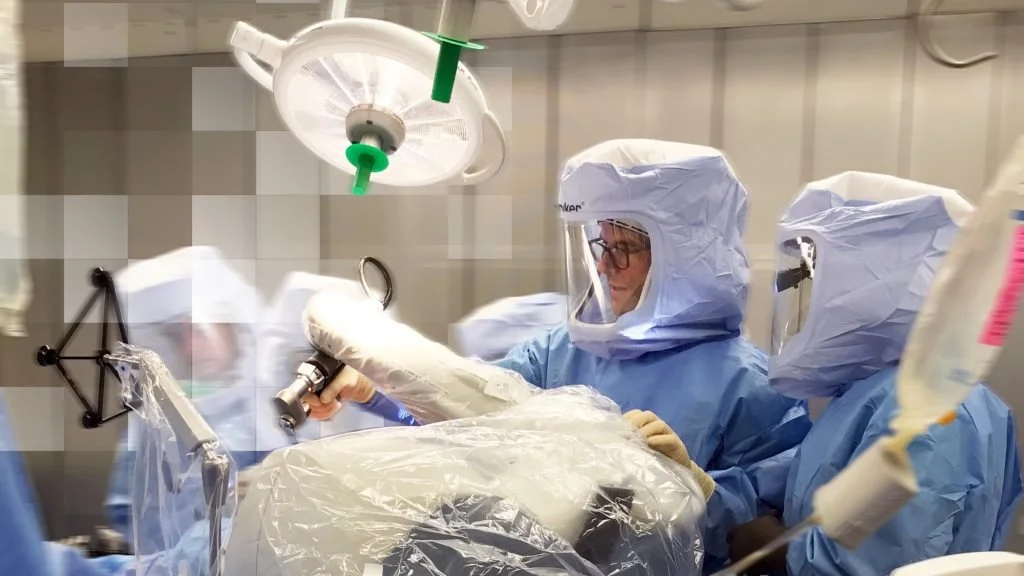
Dr. McLawhorn is among the nation's most experienced surgeons in robotic-assisted hip replacement, performing 400+ procedures annually. Before surgery, a CT scan creates a 3D model of your anatomy. Dr. McLawhorn uses this to plan the precise position, angle, and depth of your implant. During surgery, the robotic arm provides real-time guidance that ensures the implant is placed exactly as planned — achieving approximately 50% reduction in dislocation risk compared to manual placement, optimized leg length and offset, and consistent, reproducible results. Robotic assistance is available for both anterior and posterior approach surgery and is covered by most insurance plans. See the Robotic-Assisted Hip Replacement page for full details.